
SERVICES
Software Development MOT
There are probably as many ways to design and develop software as there are software developers. Software development lifecycle methodologies and project/programme management help us to standardise and communicate the process and to try to identify and adopt best practices but still there is the challenge of seemingly too many alternative approaches and the even greater challenge of how to change current culture or fix historical problems.
Fortunately, hidden in the fog of approaches and obstacles there are fundamentals. By understanding how those fundamentals interact in your organisation we avoid a one-process-fits-all approach. Seeing through the fog becomes clearer as the decades in software development and its management accumulate. From helping dozens of organizations with their challenges, Arroware has progressively formalised exactly how to understand an organisation’s development process to make it more effective.
It goes without saying that the aim is greater efficiency, shorter time to market and better product quality. Big improvements, of course, require effort, but we can now bring a measure of science and predictability to improving those practices with an analytical approach to those fundamentals.
We start with a swift but searching analysis of the current state of Asset Health, Governance and Culture of the development setup and work through the resulting tiers of specific issues to discover your unique best practice.
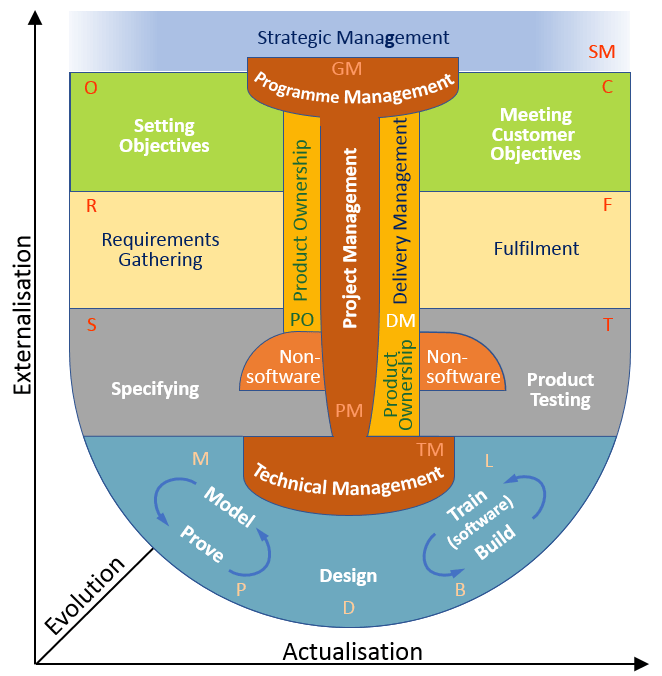
Those fundamentals are based on a robust model which includes all of the roles (or “Acts”) which are inevitably present in software development. The “Acts” – such as the Act of “Technical Design” or the Act of “Requirements Gathering” are universal. The checking of around 20 performance indicators relevant to these Acts is what we have called the Software Development MOT. To follow the metaphor, the results of it can be broken down into:
- Repair – changes required for the short term to prevent an accident
- Service – preventative work required to save money and downtime
- Tuning – longer term changes to enhance performance with minimal investment
- Super-tuning – longer term investment to bring a significant return in performance
Basing these opportunities for improvement on the fundamentals categorised in Asset Health, Governance and Culture and putting all of this into the context of the history of the organisation, will allow us to jointly come up with solutions that resonate with the staff and agree with your culture – the one-process-fits-all approach is avoided and we can draw on industry best practice and our joint creativity to find ways of improvement that are taken up quickly and, importantly, that will stick.
It means that from initial, efficient analysis from someone highly experienced in the industry we can concentrate efforts, building on your firm’s history and the experience and talents of your staff while leaving you in control to accelerate improvements with the minimum of disruption.